Upon arriving in Sevilla, we dropped our things at my apartment and made out way to two flamenco tablaos. New Year's Eve proved a frenetic day. Because the holiday loomed, the city’s major attractions planned to close early. This required that we get an early start on the day. Our first visit of the day threatened to knock us off schedule almost from the beginning – so much to see! It was probably for the best that the tower guard in La Giralda warned us of the pending noontime tolling of the bells, which hang suspended just a few feet above the viewing platform.  My sister hightailed it out of there ahead of the coming exodus to street level, placing us back on time.

Across from the Cathedral, at the Real Alcazar de Sevilla, we were able to wonder the grounds for a brief couple of hours.  Though I mean to commit a full post to the Real Alcazar at a future date (it certainly deserves one), for the sake of the pictures here I should mention that the complex was once part of an elaborate Moorish palace. Much what appears in the present, though suggestive of Moorish design, was actually built by Catholic monarchs in the mudéjar style during the medieval period. Still further additions were made during the Spanish Renaissance. As a college student, my sister worked on an exhibition of Islamic tilework that was prompted, in part, by her memory of this place back in 2001.
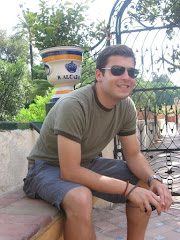
  I could tell she enjoyed showing Mike around for the first time. During the period I study, the site served successively as the residence of the Crown’s appointed representative, the meeting place of the Supreme Junta of the national resistance to the French invasion, later as the administrative seat of the French occupational regime in the region after the city’s fall, and finally, once again, as the property of the Spanish Crown at the conclusion of the war. It’s been through quite a bit! Unto the present, the site still housed several compartments that comprise a formal residence of the Crown, though I’m told the royal family has never really made us of them.

In the afternoon, we went (really by chance) to take a guided tour of the Plaza de Toros de la Real Maestraza de Sevilla, Spain’s most important bullring in the surprisingly rigid though somewhat simple cosmos of tauromaquia, and that evening we went to a nice dinner before going home to ready ourselves for the big celebration in the streets. Back at the apartment, we neatly packed bundles of twelve grapes into plastic wrap (my mother’s idea) in preparation for our trip to the square in front of the clock at city hall. As per custom in Spain, we joined the crowd to eat grapes at midnight, one for each bell chime, in order to secure our good luck for the coming year. I think only Mike was able to finish the grapes before the sound of the last bell died out – I think the rest of us were too busy laughing at him. Afterwards, out came the cava to join the street party.

New Year’s day we arose to catch a bus for Ronda, one of the more dramatic sights in all of Spain and the birthplace of the Spanish bullfight. Much of this white city rests atop sheer cliffs that drop down into the canyon that splits the canyon in two and the surrounding valley.  We spent much of the morning taking advantage of the city’s cliffside walkways, my mother and sister keeping a good distance between themselves and the railing.

If it had not been a holiday, we would have taken the dark and musty stairway built by the Moors to the canyon floor, but we contented ourselves instead with a trail that stretched along the medieval walls guarding the city’s sloping southerly approach. In the afternoon, we visited the Plaza Real Maestraza de Caballería de Ronda, Spain’s oldest bullring, where we were allowed to walk the corrals, stables, and chutes behind the main ring unattended.

The next morning I accompanied the group back to Madrid by train in order to catch their flight back to Madrid. All in all, it was a short visit, but a very fun and memorable one.
Ironically, as I post this, I’m readying myself for a visit to Barcelona, where my mother has (rather surprisingly) gone for work. However, before I write about Catalonia, I need to post a couple of other updates. Bear with me...the journey continues.